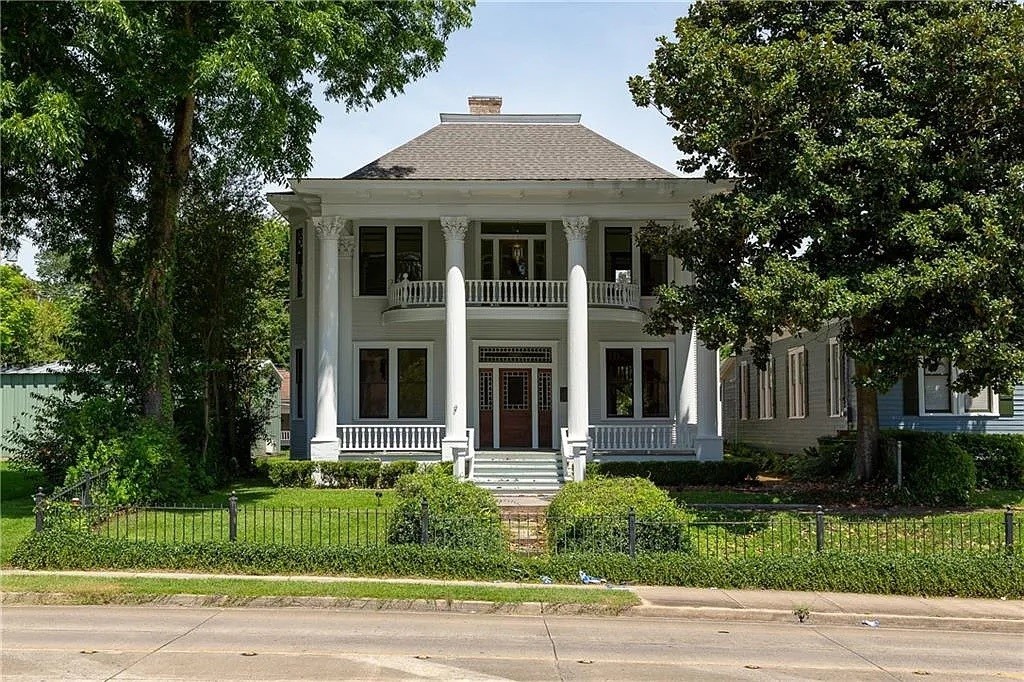
Mayer Hirsch House, circa 1909
on the National Register of Historic Places
The Mayor Hirsch House. Built in 1909, the Hirsch House is Georgian Revival with a deep front portico and four large Corinthian columns. The floor plan is a two-story four-over-four with a story and a half kitchen wing to the rear.
Downstairs rooms include the entrance, parlor, library, dining room, butler’s pantry and kitchen and enclosed rear porch. Downstairs ceiling height is 10’10”.
The entrance accommodates the spectacular suspended main staircase with its two landings, 26 treads and 144 balusters. The front door with sidelites and transom are of cypress with original hardware. The entrance woodwork, including the staircase and 4’ paneled wainscot is of virgin longleaf pine.
The entrance, parlor, dining room and library are separated by pairs of 8’ tall cypress retracting pocket doors.
The parlor features a large bay with leaded glass upper sash and a Louis XIV mantel piece of mahogany with white tiles and a bronze fireplace cover.
The dining room features 5’ paneled wainscoting grained oak faux bois. Its columned fireplace surround is oak with leaded glass cabinets above a beveled mirror and green tile and bronze fireplace cover. A swinging door from the dining room leads to the butler’s pantry and kitchen.
The woodwork in the library continues the faux-bois treatment of the dining room. The room features an oak fireplace surround with green tile and bronze fireplace cover. A doorway from the library leads onto the original rear porch – enclosed when the house was subdivided during WW II.
The porch now houses a bar and half-bath - added during the restoration in anticipation of the house’s repurpose as a restaurant.
The kitchen is a large open space that includes a large walk-in pantry, a utility closet and a service half-bath. A door in the kitchen accesses the rear stairs to the master bedroom.
Up the main staircase 2nd floor, the stair hall. Five doors lead to two bedrooms, a closet, a bathroom and the front porch balcony. Upstairs ceiling height is 9’ 6”.
The “boy’s bedroom” is a small room at the top of the stairs. Adjacent, is the bathroom with its 4’ paneled wainscot, a lavatory and toilet stall.
The front porch balcony is gracefully curved and balustraded.
The “front bedroom” features a large bay with a leaded glass upper sash matching that of the parlor and a columned and mirrored oak fireplace surround with brown and blue tiles and a bronze fireplace cover.
The master bedroom features a columned oak fireplace surround with brown tiles and bronze fireplace cover. A small built-in closet is in one corner and a door from the master bedroom leads to a spacious walk-in closet and the kitchen stairs.
The Hirsch House is located in Alexandria, Louisiana a growing progressive city in the heart of the state. With a population of 50,000, Alexandria is the center of banking and commerce for a population area of 150,000. Business is predominantly agriculture and forest products but the area is also home to manufacturing like Procter and Gamble, Dresser Industries, Union Tank Car, Plastipak, Bordon Chemical, International Paper and more. With its mild climate, the area is a paradise for year-round outdoor activities like golf, hunting, fishing, hiking and biking and was recently featured in Outdoor Magazine for one of the ten best areas in the country for outdoor living. Check out the Chamber of Commerce’s web site at www.cenlachamber.org.
The Hirsch House is prominently situated on a major thoroughfare 1 1/2 blocks from Interstate 49. Included with the house is a large paved parking lot to the rear of the house. The Hirsch House is adjacent to several other old houses, all restored and well-kept.
The Hirsch House was built in 1909 by Mayor Hirsch, a Russian emigrant who fled Odessa in 1875 at age 13. Records show Hirsch in the Alexandria area in 1890 selling housewares from a mule-drawn cart to families living along Bayou Boueff in rural Rapides Parish. By 1900, he was a partner in Blackman and Hirsch, a livery stable and livestock business. His marriage to his partner’s daughter was described in the local newspaper as “the social event of the season” - marking his rise to prosperity. Hirsch and his wife were raising their four children on a plantation south of Alexandria until an incident in 1908 involving their youngest son, Joel. As the story goes, one day, Mrs. Hirsch found three-year-old Joel playing in the yard with a snake coiled around his leg. After extracting the snake with no harm to the child, she declared to her husband over supper that she was done with country life and demanded he move the family to town. Work ensued on the Hirsch House soon thereafter and the family moved in during the spring of 1909. Mr. Hirsch expanded his business and was a valued member of Alexandria society until his death in 1920. In 1969 the house passed from the family.
I was assigned to England Air Force Base in Alexandria in 1975. I saw the house and immediately fell in love. I purchased it and together with my fiancé spent the next seven years restoring it to its original glory. Considering what to do with the house once the restoration was completed, we decided to turn it into a restaurant. Somewhere along the way though, we were brought to our senses by friends with experience in that business. We had purchased the house next door with the intention of demolishing it for parking for the restaurant but decided instead to restore it and live there and turn the Hirsch House into an antique shop. We were married in the Hirsch House in 1984 and for the next twenty years operated it as an antique shop while living next door.
Early on in the restoration we learned about the National Register of Historic Places and made application through the State Division of Historic Preservation. The Hirsch House was listed on the National Register of Historic Properties in 1979. It was only the second National Register listing in the Parish. Listing on the National Register qualifies the property for preservation tax credits. We applied for the tax credit and consequently our work on the house was monitored by the state Division of Historic Preservation. Upon completion the restoration was certified to meet the Secretary of the Interior’s guidelines for historic preservation. During restoration we discovered that much of the house was built with wood that had obviously been salvaged from another building. Framing timbers showed evidence of hewing and mortising and tennoning – things one would expect to see in much older buildings. Interior planking (All interior walls and ceilings are planked in 1” thick boards over which was applied wall and ceiling paper.) showed paint from its previous location on another building. Particularly curious were several boards painted light blue with gold stars – we were sure they held the secret of the original building. After considerable searching, we learned from an elderly member of the Hirsch family that much of the material that went into the house was indeed salvaged – from the first Jewish Temple in Alexandria build in 1872 and demolished in 1908.